



058.Battle of Cresson_a - WDS Crusades Book II
 0 - 0 - 0

| Rating: | 0 (0) |
| Games Played: | 0 |
| SM: | 1 |
| Turns: | 18 |
| Type: | Stock |
| First Side: | Crusader Alliance (CB2) |
| Second Side: | Anti-Crusader Alliance (CB2) |
Date: May 1st, 1187 - Size: Small - Location: Springs of Cresson
Crusade: Period between 2nd and 3rd Crusades
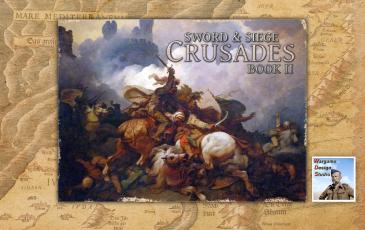
Scenario Briefing: Historical - Following the death of the young King Baldwin V in 1186, there was a brief power struggle for the crown of Jerusalem. There were essentially three contenders. Raynald of Chatillon, Count Raymond III of Tripoli, and Guy of Lusignan, the husband of Sybilla, sister of King Baldwin IV and mother to King Baldwin V. Prior to the death of Baldwin IV, it was agreed under oath, that if King Baldwin V died without an heir, the crown would be chosen by arbitration. However, before that could take place, Sybilla and her supporters crowned Guy King of Jerusalem. This was seen as a violation to the oath all had taken in 1185. As a result, Raymond III withdrew to his lands and agreed to a non-aggression pact with Saladin. In 1187, Saladin wished to raid and perform reconnaissance of the Crusader lands west of Raymond's territory and Saladin was granted permission to pass through the lands controlled by Raymond. So, while Saladin was in the middle of the siege of Kerak, he dispatched a Muslim force of 700 mounted raiders called "el-maghirin." Some contemporary sources put this number to as high as 7,000. But 700 is the modern historian's accepted strength.
In this scenario, the forces are roughly equal with a small edge given to the Muslims. The Muslims were initially surprised and will start the scenario with many disrupted and disorganized. However, the Crusaders were lined up to attack without the support of the infantry, in an attempt to take advantage of the surprise situation.
Will this moment be too much for the Muslims to recover from, or will they rally and counter-attack before the Crusader infantry can arrive.
Recommended Rules: [Default]
Can be played as either side against the AI or Head-to-Head.
Suggested Reading: Steven Runciman, A History of the Crusades, vol. II: The Kingdom of Jerusalem. Pgs. 359-360.
Crusade: Period between 2nd and 3rd Crusades
Scenario Briefing: Historical - Following the death of the young King Baldwin V in 1186, there was a brief power struggle for the crown of Jerusalem. There were essentially three contenders. Raynald of Chatillon, Count Raymond III of Tripoli, and Guy of Lusignan, the husband of Sybilla, sister of King Baldwin IV and mother to King Baldwin V. Prior to the death of Baldwin IV, it was agreed under oath, that if King Baldwin V died without an heir, the crown would be chosen by arbitration. However, before that could take place, Sybilla and her supporters crowned Guy King of Jerusalem. This was seen as a violation to the oath all had taken in 1185. As a result, Raymond III withdrew to his lands and agreed to a non-aggression pact with Saladin. In 1187, Saladin wished to raid and perform reconnaissance of the Crusader lands west of Raymond's territory and Saladin was granted permission to pass through the lands controlled by Raymond. So, while Saladin was in the middle of the siege of Kerak, he dispatched a Muslim force of 700 mounted raiders called "el-maghirin." Some contemporary sources put this number to as high as 7,000. But 700 is the modern historian's accepted strength.
In this scenario, the forces are roughly equal with a small edge given to the Muslims. The Muslims were initially surprised and will start the scenario with many disrupted and disorganized. However, the Crusaders were lined up to attack without the support of the infantry, in an attempt to take advantage of the surprise situation.
Will this moment be too much for the Muslims to recover from, or will they rally and counter-attack before the Crusader infantry can arrive.
Recommended Rules: [Default]
Can be played as either side against the AI or Head-to-Head.
Suggested Reading: Steven Runciman, A History of the Crusades, vol. II: The Kingdom of Jerusalem. Pgs. 359-360.


)